
Understand the Decisions Behind Each Blackjack Hand
 Available in US
See how card values, table rules and choices such as hitting, standing, doubling or splitting affect play against the dealer.
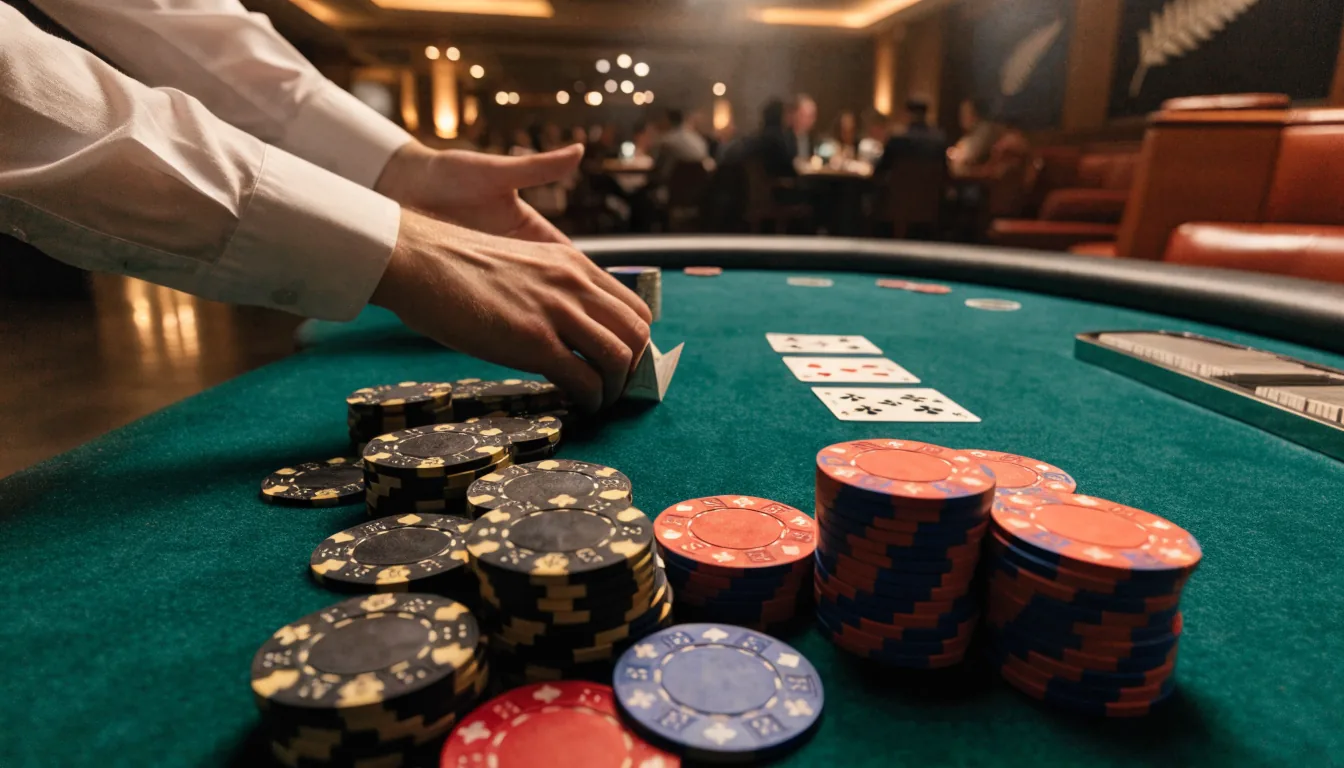
How Blackjack Is Played at a Casino Table
Blackjack is a contest between each player and the dealer, rather than a game in which the players compete against one another. The aim is to finish with a hand closer to 21 than the dealer’s without going above that total. This shared objective gives the game its familiar structure: a dealer conducts play at a table while several players may take part in the same round.
At a casino blackjack table, the dealer manages the cards and the sequence of play. Players make decisions about their own hands, but the dealer’s hand provides the comparison that determines the result. A player can therefore have a hand that would be strong in isolation and still lose if the dealer finishes closer to 21. Conversely, a hand need not reach 21 to prevail; the relevant comparison is with the dealer, provided the player has not exceeded the target.
The table setting makes this relationship visible. Players sit around a shared gaming surface, with the dealer positioned to handle the cards and oversee the round. Each player’s hand is treated separately, even though the dealer conducts the game for the table as a whole. The other participants are part of the same live setting, but the central comparison remains between an individual player’s hand and the dealer’s hand.
A live blackjack table uses actual playing cards. The dealer handles and distributes them, so the game unfolds through physical cards rather than an on-screen animation generated solely by software. That distinction is part of what makes a live-dealer game resemble a casino table: the cards are real, and the dealing is presented as it happens. When the game is streamed, however, the video connection can introduce delay. Live presentation does not necessarily mean that every action appears instantly.

The phrase “blackjack table” can refer to more than the physical furniture. It also describes the organised setting in which the dealer, players, cards and round come together. In a land-based casino, the table is a specific place in the gaming area. In a live online game, the view may show a dealer and table through a stream, while players participate remotely. In either case, the defining contest is still against the dealer, and the goal remains to finish nearer to 21 without exceeding it.
A casino blackjack table layout helps separate the dealer’s role from the players’ participation. The dealer’s working area is distinct from the places where players follow their own hands. That arrangement supports a shared round without turning it into a single collective hand: each player is assessed individually against the dealer. The visual layout can make it easier to follow who is taking part, which cards belong to which hand, and where the round is in its progress.
The number of people at a table can affect how busy the shared setting feels, but it does not change the basic objective. With other casino blackjack table players present, the dealer still conducts the same kind of contest for each participant. The pace may feel different from a table with fewer participants, because the activity is shared, but the comparison is not between one player and another. A player’s outcome depends on the player’s hand and the dealer’s hand.
The expression “21 blackjack table” points to the target that gives the game its name. It should not be read as meaning that every successful hand must total exactly 21. The objective is comparative: a player seeks a hand closer to 21 than the dealer’s while staying within the target. That distinction matters because the game is not simply a race to reach a particular total. It is possible for the dealer’s result to determine the outcome even when a player has not reached 21.

Online descriptions can use similar table language for different formats. A live blackjack table online presents a dealer handling actual cards, with streaming as part of the experience. The stream may delay the game or come with higher bets than a land-based table. Those practical differences do not alter the basic dealer-versus-player structure, but they mean that a streamed table is not identical in every respect to sitting at a casino table.
The table itself is therefore best understood as the setting for a repeated comparison, not as a guarantee of any particular outcome or pace. The dealer administers the game, players hold separate hands, and each result turns on how those hands compare with the dealer’s without passing 21. This basic picture applies whether the table is physically present in a casino or shown through a live stream.
Blackjack Rules, Card Values and Payouts
Blackjack rules set out how card totals are calculated, which actions are available and how a winning hand is paid. The details are not identical at every casino table. A clear comparison therefore depends on the rules for the particular game, rather than on the name “blackjack” alone.
Card values and hand totals
Number cards count at their printed face values. Each jack, queen and king is worth ten, while an ace may count as either one or eleven. The ace’s value can make a hand flexible: its total depends on which value keeps the hand valid. A hand that includes an ace counted as eleven is commonly described as a soft hand; if the ace must count as one, the hand is hard.
A natural blackjack is the two-card combination of an ace and a ten-value card. It is distinct from reaching the same total with additional cards. That distinction matters because the payout for a natural may differ from the payout for an ordinary winning hand. The table’s rules determine how the two outcomes are treated.

Player actions and dealer conditions
The principal player actions are hit, stand, double down and split. Hitting adds a card to the hand; standing ends the player’s turn with the current total. Doubling down and splitting are also recognised actions, although the conditions under which they are allowed depend on the table. Surrender may be available at some tables as well, but it is not a universal option.
These terms describe the structure of play, not a prescribed choice in any particular situation. The rules specify when an action is permitted and what follows from it. For instance, a table may set conditions for doubling or splitting, while another may handle those actions differently. A blackjack table guide is most useful when it distinguishes the general action names from the conditions attached to them.
The dealer’s treatment of a soft seventeen is another rule to identify. Some games require the dealer to take a card on that hand; others require the dealer to stand. Because the dealer follows the table’s stated procedure, this condition can affect how a hand resolves even though the player’s card values are unchanged.
Rules that differ between tables
The number of decks in use can vary, as can the dealer’s rule on soft seventeen. Surrender availability and blackjack payouts also differ between games. These are material details of casino blackjack table rules, rather than cosmetic variations. A table’s posted rules or game information should be read as a set: a single feature does not describe the full conditions.
The distinction is particularly relevant when comparing a game advertised as blackjack with another version carrying the same broad label. One may offer surrender while another does not; one may use a different dealer procedure or payout. Such differences mean that blackjack table rules cannot be assumed to apply universally across casinos or variants.
Deck Count
The number of decks used in the game can vary between different tables.
Soft 17 Rule
Dealer procedures differ on whether they must hit or stand on a soft seventeen.
Surrender Option
The availability of the surrender action is not universal and varies by table.
Natural Payouts
The payout ratio for a natural blackjack can differ, such as 3:2 or 6:5.
Natural-blackjack payouts
A natural blackjack often pays at a ratio of 3:2, while some tables use 6:5. These ratios describe the profit relative to the original wager, with the original stake treated separately. The payout is attached to a natural blackjack, not automatically to every hand that reaches a total of twenty-one.
The payout figures should not be read as a settled description of all casino tables. One specialist review reports both the 3:2 and 6:5 arrangements, illustrating why the specific game terms matter. A table’s own rules establish which payout applies there. The same care is needed with other conditions, since the deck count, dealer procedure and available actions may also vary.
“Blackjack table price” is not a rule category in the same sense as card value or payout. In practical comparisons, the relevant information is the table’s stated terms and the wager conditions shown for that game. Those conditions should be considered together: the payout for a natural alone does not reveal the dealer’s soft-seventeen rule, whether surrender is offered, or which actions are permitted.
Online Blackjack in New Zealand in 2026
Choosing a blackjack table in New Zealand means checking the information available about each operator before deciding where to play. This list gives a concise reference point based on the details provided for each one.
-
Zotabet
- License
- 07017519840
- Payout speed
- 1-3 business days
Zotabet lists licence number 07017519840 and payouts of 1–3 business days.
-
BitStarz
- License
- Curaçao Gaming Authority, licence no. OGL/2024/165/0185
BitStarz lists a Curaçao Gaming Authority licence, number OGL/2024/165/0185.
-
Neospin
- License
- Tobique Gaming Commission, licence no. 0000064
Neospin lists a Tobique Gaming Commission licence, number 0000064.
-
Lamabet
- Payout speed
- 1-3 business days
Lamabet lists payouts of 1–3 business days.
-
N1 Casino
- License
- Malta Gaming Authority, licence no. MGA/B2C/394/2017
N1 Casino lists a Malta Gaming Authority licence, number MGA/B2C/394/2017.
-
Wintino
- Payout speed
- 1-3 business days
Wintino lists payouts of 1–3 business days.
-
7Bit Casino
- License
- Tobique Gaming Commission, licence no. 0000091
7Bit Casino lists a Tobique Gaming Commission licence, number 0000091.
-
Ricky Casino
- License
- Tobique Gaming Commission, licence no. 0000002
Ricky Casino lists a Tobique Gaming Commission licence, number 0000002.
-
Play Grand
- License
- Malta Gaming Authority, licence no. MGA/B2C/370/2017
Play Grand lists a Malta Gaming Authority licence, number MGA/B2C/370/2017.
An online blackjack table may be generated entirely by software or presented through a live dealer. The distinction affects how cards are produced and how quickly a hand progresses. It also sits within a changing New Zealand regulatory framework: the legal position in 2026 is transitional, rather than the settled operation of a fully established domestic licensing system.
Software-based and live-dealer games
In RNG blackjack, software shuffles and deals the cards. Because a physical dealer and streamed table are not part of the process, hands can move more quickly than in a live-dealer game. The digital interface presents the cards and available actions, while the game’s software determines the shuffle.
A live-dealer game instead uses actual cards at a streamed table. Its format is closer to a casino table blackjack game, with a dealer handling the cards on screen. Streaming can introduce delays, and some live tables may require higher bets than software-based games. These are practical differences between formats, not evidence that one type produces better results.
The label “online blackjack” therefore covers more than one experience. A software table prioritises speed and a digital presentation; a live table adds a human dealer and a video feed. Neither format changes the underlying objective of playing against the dealer, but this section concerns the delivery of the game rather than how to choose actions at the table.

New Zealand’s licensing transition
The Online Casino Gambling Act 2026 created New Zealand’s first domestic licensing framework for online casino gambling and took effect on 1 May 2026. Its transition period runs from that date through 1 December 2026. During this interval, online casino providers that were already serving people in New Zealand before the Act began may continue operating under the transitional provisions.
This does not mean that a fully operational licensing market is already in place. The complete regime is not expected to be running until 2027. The Gambling Act 2003 had prohibited online casinos from being based in New Zealand, and the new law establishes a route to domestic licensing rather than simply extending the former position.
Institutional responsibilities are divided. The Department of Internal Affairs is New Zealand’s primary gambling regulator and oversees the online casino licensing framework. The Gambling Commission hears and determines casino licence applications, issues licences, and approves changes to licence conditions. These roles describe the regulatory structure; they do not establish that every online service available to New Zealand residents holds a domestic licence.
Before the 2026 Act, online casino gambling supplied from outside New Zealand was not licensed or supervised by a New Zealand regulator. Customers using offshore websites during that period had no domestic government recourse. The transition changes the legal framework, but it does not erase that earlier distinction or make an offshore service equivalent to a domestically licensed provider.
The transition also places restrictions on promotion: online casino gambling must not be advertised to people in New Zealand during this period. Providers that were not operating in the market before 1 May 2026 do not fall within the stated permission for existing services to continue. The timing matters because a service’s availability online, by itself, does not show that it has a New Zealand licence.
What the date means for players
For someone comparing an online blackjack table with a casino table, two questions should remain separate: whether the game is RNG or live-dealer, and what regulatory status applies to its provider. The first concerns pace and presentation. The second concerns the transition from the earlier offshore environment to domestic licensing.
The 2026 framework is not yet the same as a fully operational licensing regime. During the transition, online casino providers already active before the commencement date may continue under the Act’s provisions, while the licensing system is being established. The Gambling Commission’s role in applications and licence conditions and the Department of Internal Affairs’ oversight define the intended framework; they should not be read as a blanket assurance about every site displaying blackjack.

Strategy, Rule Variations and Insurance
Blackjack strategy is conditional on the rules of the game. A recommendation derived for one variant may not apply at another table, because differences in rules can change both the available decisions and the house edge. A strategy chart is therefore not a universal prescription: its assumptions need to match the game being played before its guidance can be interpreted.
The relevant conditions include the number of decks, how the dealer handles a soft 17, whether surrender is offered, and the payout for a natural blackjack. These details can alter the comparison between possible decisions. A chart that omits its assumptions, or is based on a different rule set, may give a misleading impression of precision. Even when the rules match, a strategy describes choices under specified conditions; it does not determine the outcome of an individual hand.
A blackjack pay table is one place to check the stated payout conditions, but it should be read alongside the table rules rather than treated as a complete description of the game. Payouts are not uniform across variants. A specialist review has reported both 3:2 and 6:5 payouts for a natural blackjack, illustrating why the figure shown for a particular game matters. That report is not evidence that either payout is standard across New Zealand tables.
A blackjack probability table also depends on assumptions. Probabilities calculated for a particular deck composition or set of rules cannot automatically be transferred to a different game. Such tables can clarify how a model treats possible outcomes, but they do not predict the next hand with certainty. Similarly, a blackjack surrender table is relevant only where surrender is permitted and where its recommendations correspond to the rules in force. If the option is absent, that part of the reference has no practical application.
Do
- Match strategy chart assumptions to the specific table rules
- Check the payout for a natural blackjack
- Use money management to limit financial exposure
Don't
- Treat a strategy chart as a guarantee of profit
- Apply one variant's strategy to a table with different rules
- Chase losses by increasing stakes
The same caution applies to advice described as basic strategy. Its purpose is to organise decisions for specified hand and dealer-card situations, not to provide a guarantee of profit. Rule changes may affect which choice is preferable, while variation in outcomes remains part of the game. A private blackjack table is not necessarily governed by a different strategic principle, but its specific rules still need to be established; the label alone does not disclose them.
Card counting is a separate issue from consulting a strategy chart. In New Zealand, using mental calculation to count cards is not illegal under the law. That legal point does not establish that counting will produce an advantage in a given setting, nor does it guarantee a favourable result. The effect of any count depends on circumstances that a general guide cannot settle. It should not be confused with a method that removes the house edge or ensures winnings.
Insurance also requires a restrained assessment. It is an optional wager associated with the dealer’s visible card, not protection against losses across the game as a whole. Its value depends on the rules and the information available at that moment. For most players, it should be avoided as a bet; the name does not make it a broadly protective choice. A strategy reference that discusses insurance should state the conditions behind its recommendation rather than presenting the option as automatically worthwhile.
Money management does not change the mathematical terms of a game, but it can limit exposure. A predetermined budget and a decision not to chase losses are relevant safeguards; neither alters the chance of a hand’s outcome. Where play is connected to a bonus, blackjack may count differently toward wagering requirements, and maximum-bet rules may apply during wagering. Those conditions should be checked in the applicable terms, along with other bonus restrictions, before play begins.

Betting, Chips and Electronic Blackjack
At a staffed blackjack table, chips make the wager visible and allow the dealer to handle the betting process without cash changing hands during each decision. A player places chips in the designated betting area before a hand begins; after the hand, the dealer settles the wager according to its outcome and the table’s procedures. The exact layout and handling can differ, so the table’s posted instructions take precedence.
This physical arrangement is what many people mean by a blackjack betting table: a marked surface where each player has a place for a wager and where cards and chips move through a shared game. The chips represent the amount staked, while their colour or denomination distinguishes values. Their appearance does not alter the rules of the hand, and a larger-looking stack does not indicate a greater likelihood of winning.
For online play, the betting interface replaces the physical chip area. A screen may present selectable chip values or controls for entering a wager, alongside a balance and the current hand. These are interface elements, not evidence that a particular bet is more favourable. The amount selected determines the stake for that hand, subject to the game’s own terms and any applicable table conditions.
Electronic and live-dealer formats
An electronic blackjack table game can refer to a software-based game in which a random number generator determines the cards. The software shuffles rather than a dealer handling a physical deck, and the pace can be faster than in a live-dealer game. That speed changes how quickly hands can be completed; it does not establish that the game is easier to win or that losses are less likely.

Live-dealer blackjack uses actual cards and presents the game through a stream. It retains the visual presence of a staffed table, but streaming can introduce delays and the game may require higher bets. The betting controls still appear on screen, so the interface combines a digital wager with a dealer-led game. In contrast, RNG play is generated by software and does not depend on a live table’s dealing pace.
The distinction matters when considering the role of chips. At a physical table, chips are tangible markers handled by players and dealer. In electronic play, any chip-like symbols are visual representations of a digital wager. Neither format makes the amount staked a measure of skill, and neither removes the uncertainty of the result.
For real-money play, the betting display should be read alongside the relevant terms, including any bonus conditions and wagering requirements. Blackjack may count differently toward wagering requirements, and maximum-bet rules can apply while those requirements are active. A budget set in advance can keep wagering bounded; increasing stakes to recover losses does not ensure recovery.
When to Hit, Stand, Double Down or Split
Blackjack decisions turn on a simple aim: finish closer to twenty-one than the dealer without exceeding it. Hitting, standing, doubling down and splitting are the principal actions available to a player, but they serve different purposes. Their practical value depends on the cards in play and the rules of the particular table; no single action is right in every situation.
To hit is to take another card. This may improve a hand that is well short of twenty-one, but it also creates the possibility of going over. The choice therefore involves weighing the value of another card against the risk of busting. A hit does not guarantee that a weak hand will become competitive, and taking cards repeatedly is not automatically safer than stopping.
To stand is to take no further cards and let the hand proceed to comparison with the dealer’s. Standing avoids the risk of exceeding twenty-one through another hit, but leaves the current total unchanged. It can be considered when the hand is judged sufficient to compete, though the dealer’s eventual result remains unknown. Standing is not a way to secure a win; it simply ends the player’s drawing.
Doubling down allows the player to increase the wager in connection with the hand and take a further card, after which no more cards are drawn for that hand. The option can make a favourable situation more consequential, but it also increases the amount at stake. Whether it is permitted, and on what terms, depends on the table’s rules. It is distinct from merely hitting because the player commits to a limited continuation.
Splitting separates an eligible starting hand into two hands, each played independently. This changes one decision into two, with the potential for different outcomes and additional wagering. The option is available only under the conditions set by the table, so a pair does not necessarily mean that every split is allowed. It also does not ensure that either resulting hand will improve.
Blackjack Actions
-
1
Hit
Take another card to improve a hand that is well short of twenty-one, weighing the gain against the risk of busting.
-
2
Stand
End the drawing phase and keep the current total to compare it against the dealer's final hand.
-
3
Double Down
Increase the wager and take exactly one more card to maximize a favourable situation.
-
4
Split
Separate a pair into two independent hands, each requiring its own wagering and decisions.
A useful reference table can set out the available actions beside hand situations, but it should not be treated as a universal instruction sheet. A recommendation may change when the rules change, and the decision still carries uncertainty. The action names describe what a player may do; they do not predict the next card or guarantee a result.
The minimum stake shown for a table does not, by itself, establish its maximum bet. That limit is a separate table condition, so a low entry stake should not be read as evidence of how large a wager may become.
Seating at a Blackjack Table: What the Evidence Supports
Choosing a seat at a blackjack table can affect how the game feels, but seat preference and a strategic advantage are different claims. Blackjack is played against the dealer, with the aim of finishing closer to 21 without going over. A position at the table does not change that objective.
The phrase “best place to sit” can imply that one position improves the chance of a favourable result. That conclusion does not follow from the basic structure of the game. The dealer remains the opponent regardless of where a player sits, and the seat itself does not alter the aim of the hand. No particular position can therefore be identified as a better choice on strategic grounds.
Seat choice may still matter for reasons unrelated to the outcome. A player may prefer a position that feels comfortable or makes it easier to follow the table. Those preferences are personal and should not be confused with a demonstrated effect on results. A seat that seems convenient is not, on that basis, more likely to produce a win.
This distinction is useful because table customs and perceptions can sound like advice. Claims that a certain seat is “lucky”, that one position controls the table’s results, or that moving seats changes a player’s prospects require evidence beyond personal impressions. Without a demonstrated connection between position and outcomes, such claims remain beliefs rather than reliable guidance.
The same care applies when comparing blackjack tables. A different table or seat may change the setting, but the position alone does not establish a strategic benefit. The relevant question is whether there is a verifiable reason to expect a different result—not whether a seat has a reputation or feels preferable.
For practical purposes, seating can be treated as a matter of comfort and preference, not as a method for improving the odds. A clear distinction between those categories avoids assigning predictive power to a position without support. The dealer-versus-player objective remains the same across the table: finish nearer to 21 than the dealer without exceeding it.
Reading a Blackjack Card-Value Chart
A blackjack card-value chart is a compact reference to the points assigned to each card. It can clarify how a hand’s total is described, but it does not show which action to take or predict the dealer’s cards. A blackjack card table should therefore be read as a guide to values, not as a strategy chart.
Number cards retain the value printed on them. A card marked with a number contributes that many points to the hand total. Face cards—kings, queens and jacks—each count as 10. Their different designs do not give them different point values.
The ace is the value that needs particular attention. It may count as either 1 or 11, so its contribution depends
Using a Blackjack Cheat Sheet Without Treating It as a Guarantee
A blackjack cheat sheet is best understood as a compact reference to possible decisions, not as a promise of a particular result. It can organise guidance around the choices available during a hand: hit, stand, double down or split. Its purpose is to make decision information easier to consult, rather than to remove uncertainty from the game.
A reference sheet is useful only in relation to the version of blackjack being played. Variants do not all follow identical rules, and those differences can affect both strategy and the house edge. A chart prepared for one set of conditions may therefore give unsuitable guidance at a table with different rules. The label “blackjack cheat table” does not, by itself, establish that a chart matches a particular game.
The distinction between a decision aid and a guarantee matters. Even when a sheet is designed for a relevant variant, it cannot determine the outcome of an individual hand. It offers guidance about available choices under stated assumptions; it does not ensure that a choice will win, nor does it eliminate the house edge. Treating a chart as an infallible system overstates what such a reference can do.
Before relying on a table cheat sheet, the game’s rules need to be considered alongside the chart’s stated scope. If that scope is unclear, its recommendations cannot be confidently transferred to the game in front of the player. The same caution applies when a sheet presents guidance without indicating the variant to which it relates: its apparent precision does not establish that it fits.
A sound reference is therefore specific about the conditions behind its recommendations and limited in what it claims. It can help keep the available actions visible, but it cannot substitute for understanding the rules or turn blackjack into a guaranteed outcome.
Blackjack Table Limits and Payout Conditions
A blackjack table limit sets the permitted range of wagers at that table. The posted minimum and maximum define that range; they do not, by themselves, describe the rules for resolving a hand or the amount paid for a win. No single limit can be assumed across all tables, so a figure associated with one game should not be treated as a market-wide standard.
Payout conditions are a separate part of the game’s terms. A natural blackjack is not necessarily paid at the same rate everywhere: a specialist review reports that some tables pay 3:2, while others pay 6:5. Those ratios are specific terms to verify for the particular game, rather than a basis for assuming what an unexamined table will pay.
Other rules may also differ. A specialist review notes variation in deck count, whether the dealer hits or stands on soft 17, surrender availability and blackjack payouts. These details can affect how a table operates and should be read together, rather than inferred from the table limit or its name. The amount that may be wagered and the conditions attached to a winning hand answer different questions.
Promotional play can introduce additional restrictions. Blackjack may contribute differently to wagering requirements than other games, and maximum-bet rules may apply while those requirements are being met. Such conditions are distinct from the table’s ordinary betting range. Before playing for money, the applicable fine print and bonus conditions should be checked on trustworthy sites and casinos; a promotion’s headline does not establish how blackjack wagers count.
A stated limit is therefore useful only within its scope: it identifies the permitted wager range for that table, not the payout terms or every condition attached to play. A budget set in advance can help keep spending bounded, while pursuing losses can increase exposure without changing the table’s rules. The available information does not support a universal minimum or maximum for blackjack tables in New Zealand; the posted terms for a specific game are the relevant reference.
Casino Games in New Zealand: Roulette, Blackjack & More
Content created by the «casinopaymentadvisernz.com» team